
ST. LOUIS 鈥� On a Sunday in mid-March, Carmen Hill stood before fellow worshippers at a small brick church in north 最新杏吧原创 to deliver announcements, as she does every week, and told the congregation about an unusual ceremony coming in late April.
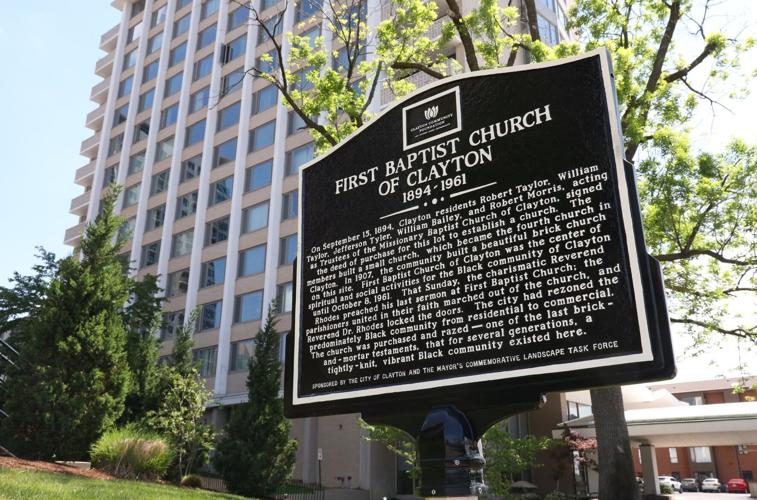
The city of Clayton, six miles to the southwest, was preparing to dedicate a historical marker at the site of the church's original sanctuary, at 216 South Brentwood Boulevard.
Hill, 70, attended the original church, known then as First Baptist Church of Clayton, as a child until it was forced to shutter in 1961, unable to fend off the forces of development in what would become Clayton鈥檚 commercial district.
She was happy with the plaque, she said.
鈥淚'm glad they're recognizing us, for one, because it's been a long time coming,鈥� Hill said.
People are also reading…
鈥淚t would be nice if there were some kind of reparations, though.鈥�
For almost 70 years, First Baptist served a small but thriving African American neighborhood on a few blocks north of what is now Forest Park Parkway. Then Clayton began to rezone its central district. Businesses and commerce arrived. Property taxes soared. Historians and former residents say the city, in effect, pushed out its Black population.
Now some here, from church leaders to city officials to regular Clayton residents, are considering how to make things right for the residents who left.
The plaque will be unveiled Thursday. But perhaps, several say, the church deserves more than a historical marker for the actions of Clayton's past.

This historic marker is near the corner of Bonhomme and Brentwood Ave. in Clayton on Sunday, April 26, 2026. The sign commemorates the church's original location before it moved to Union Blvd.
Jerry King, a retired developer and Clayton resident, believes the church should be paid.
鈥淭he city of Clayton could deal with reparations by providing scholarships for schooling, by providing daycare for low income Black families, and somehow making some kind of reparations as a community for what happened,鈥� he said.
Few government bodies, if any, have compensated a church community for razing a house of worship. But cities have paid for other reasons:
In 2021, the state of California returned prime beachfront property to the descendants of , a Black couple. The city of Manhattan Beach had seized the beach using eminent domain nearly a century earlier.
That same year, Evanston, Illinois, started providing $25,000 to eligible Black residents who lived in the city between 1919 and 1969, or to their descendants. Also in 2021, Durham, North Carolina, allocated $6 million , including green infrastructure in historically Black neighborhoods.
In 最新杏吧原创, a commission established in 2022 studied how the city should assess race-based harms and propose reparations. The , issued in 2024, suggested grants, loans and cash payments to people displaced from McRee Town, Mill Creek Valley and the Pruitt-Igoe public housing project.
Clayton Mayor Bridget McAndrew knows a plaque for the church, now called Clayton Missionary Baptist, isn't enough.
鈥淚 think probably anything we could do is never going to be enough,鈥� McAndrew said. 鈥淚 don't know how to rectify past wrongs other than hoping that conversation and recognition of our history prevents ongoing injustice in the future.鈥�

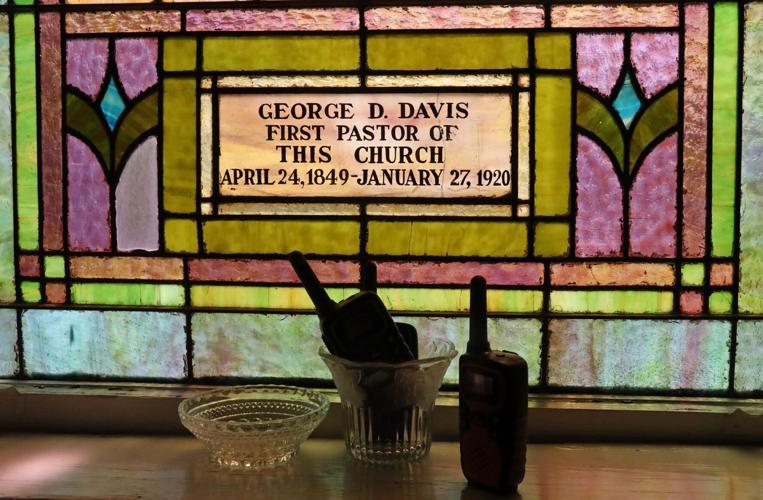
A stained glass window dedicated to the first pastor of Clayton Missionary Baptist Church is seen聽Sunday, April 26, 2026, at the church's current location in north 最新杏吧原创.
King, the retired developer, said he would be willing to pay an extra tax to support reparation efforts.
King, 84, said he played his own role in displacing Central West End residents when he served as executive director for the Washington University Medical Center Redevelopment Corp., which began work in the 1960s.
鈥淚'm ashamed in some ways of my involvement in that,鈥� he said. 鈥淚 wasn't nearly as sensitive to the issues of gentrification and the effect of that on the lower income and racially diverse populations that were in those areas.鈥�
He thinks Clayton has the chance to do better.
鈥淧utting up plaques, that doesn't really address the issue,鈥� King said.
'Reparations? It would be hard to prove'
The relocation of Clayton Missionary Baptist Church was not much of a choice for Rev. W.L. Rhodes and his congregation.
As part of the urban renewal push that started around the late 1940s and early 1950s, Clayton changed zoning laws to accommodate commercial development.
According to local historian Donna Rogers-Beard, property taxes rose sharply for home and business owners in the neighborhoods that now comprise the city鈥檚 bustling commercial district, including the church. Most of the people affected were Black, although a few white families also had to move.
鈥淭he erasure was complete,鈥� Rogers-Beard said of the dislocation of Black Clayton residents.
Rogers-Beard said that city representatives went door to door, offering above-market prices to buy homes.
鈥淚t was the same urban renewal that was going across the country,鈥� Rogers-Beard said. 鈥淎nd leaders talked about areas that did not represent the city well. Then the talk turned to a commercial center for Clayton.鈥�
But reparations for the church now would be a hard sell, she said.
鈥淩eparations? It would be hard to prove that what happened was racial,鈥� said Rogers-Beard. 鈥淏ecause, one, it was an integrated community. Two, there were no racial covenants in that area.鈥�
Seeking to recognize past injustices and displaced Clayton communities, former mayor Michelle Harris formed a task force overseeing the installation of several plaques early in her tenure from 2019-2025. The plaque at the church site is just one. Another honors Filipinos displayed as savages at the 1904 World's Fair, another the Osage Nation forced to cede ancestral land. Three represent Black neighborhood sites.
But Harris said her term ended before she could see all of her ideas through.
鈥淢y goal was to get as many sites commemorated as I could, and then to have their history on our website, and to then start doing public education about it, which I didn't really get to do,鈥� Harris said.
The markers bear witness to the lives of between 800 and 1000 Black Claytonians who had to leave their lives behind to make way for new development. Rogers-Beard said Black families lived along Hanley Road, Forsyth Boulevard and Bonhomme Avenue. Some had been in Clayton as far back as the 1870s. Today, on Hanley Road, there is a car wash where the home of the well-known McKay family once stood.
鈥淭he church was sort of a central part of the Black community鈥檚 connectedness, and I think that was kind of the last connecting piece for the Black community in Clayton,鈥� Harris said.

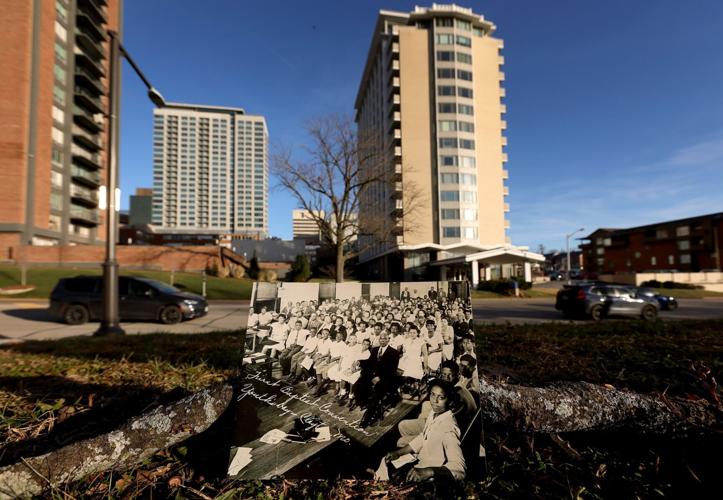
A photo of the 1946 鈥淔irst Baptist Convention Youths Day,鈥� taken at the First Baptist Church of Clayton, is placed across the street from where the church used to stand on South Brentwood Boulevard on Dec. 19, 2025. The church served a thriving Black neighborhood before being forced to move in the early 1960s after an聽all-white board of aldermen rezoned the land for聽commercial use.
A church united
Sitting on a gleaming wooden pew after choir practice on Holy Saturday, Hill said she was about five years old when the church closed its doors and moved to 2801 Union Boulevard in the Wells-Goodfellow neighborhood of 最新杏吧原创. Clayton Missionary Baptist Church has been operating there ever since
Hill said her primary impression from that time was a sense of unity and continuity fostered by Rhodes, who would lead the church for more than 60 years.
鈥淚 could see the camaraderie, the support and the love that they still had for one another that we brought with us from Clayton,鈥� Hill said.

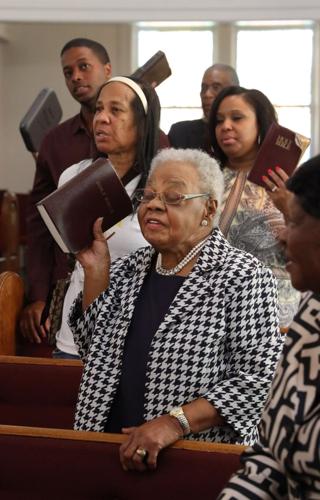
Lillie Lacy, 94, holds up her Bible during scripture readings on Sunday, April 26, 2026, at Clayton Missionary Baptist Church in 最新杏吧原创. Lacy is the oldest member of the church.
Hill鈥檚 mother, uncles and grandmother were all active members of the congregation. It continued to serve Clayton鈥檚 Black community, but drew worshippers from across the region.
She remembers details from the original church: The smell of food cooking in the church basement. Her grandmother singing in the choir. The meetings and conventions held there, often statewide and even national in scope. Hill even remembers watching white children frolic across the street in Shaw Park.
鈥淚 would sit out on the stoop and watch the people over there,鈥� she said. 鈥淭hey would skate, and I wanted to swim. But at that time, Blacks were not allowed. So I would sit out on the stoop and watch them.鈥�
Hill said the trauma of displacement was not discussed, at least around her five-year-old ears.
For a short period after the church closed, it remained standing next to Barclay House, shuttered and at least twice the target of vandals.
鈥淭his was an important place,鈥� Rogers-Beard said. 鈥淪o many people came to this church from Wellston, from Kirkwood, from Creve Coeur, from Webster Groves. It was known around the state.鈥�
Rhodes preached his last sermon at the original Clayton Missionary Baptist Church on Sept. 29, 1961. Afterward, Rogers-Beard said, he locked the building鈥檚 doors and led the congregants in a solemn procession around the building. It was razed just over one year later, according to city records.
Today, the property where the church once stood is occupied by a parking lot next to Bethesda Barclay House, a high-rise senior living building at 230 South Brentwood Boulevard. If you鈥檙e heading north on Brentwood you might spot the historical marker on the roadside.
鈥淧eople need to know the history,鈥� Hill said. 鈥淪o many people that live in Clayton now don't have a clue that Black people used to live in Clayton.鈥�
What is owed?
Pastor L. James Tate, who leads Clayton Mission Baptist Church today, never imagined that his first job leading a congregation would be in 最新杏吧原创, where he was born but did not grow up, and didn't know of the church's story.
鈥淚 felt honored when I learned about the history of it, and how it started in Clayton, and how things happened,鈥� said Tate, 45, the church鈥檚 sixth pastor.
Sitting in the small church office the day before Easter Sunday, Tate considered the historical marker that put the church back on the map, so to speak.
鈥淪omething more is needed,鈥� he said. 鈥淓ven if it's as small as an apology or some type of monetary gift to say, 鈥楬ey, you know, what happened then was not right.鈥� Not just a plaque.

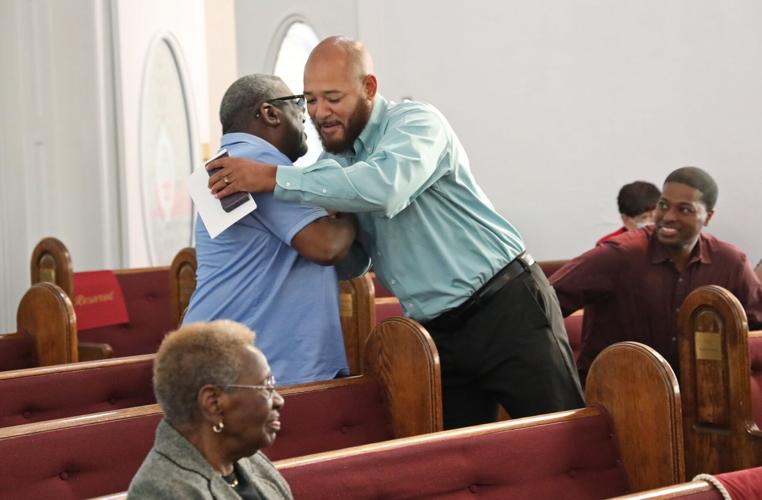
Dr. L. James Tate, pastor, right, greets parishoner Cedric Lacy, 70, on Sunday, April 26, 2026 at the Clayton Missionary Baptist Church in 最新杏吧原创. Lacy, along with several other attendees, announced that it was their birthday this week.
Tate said monetary reparations from the city of Clayton would go toward growing and expanding the church鈥檚 ministry. He wondered, half-joking, if a recreation center serving North City residents might be a fitting way for Clayton to make reparations.
鈥淕od has sustained us,鈥� he said. 鈥淏ut we could do more.鈥�
Harris, the former Clayton mayor, said at least one person has asked whether the land itself, where the parking lot now sits, could be restored to the church.
鈥淭hat's the thing that comes to mind for a lot of people when they think of, you know, making some kind of reparation or compensation,鈥� she said.
McAndrew, Clayton鈥檚 current mayor, said the city鈥檚 Equity Commission has not recommended plans for additional reparation efforts. She will be part of Thursday鈥檚 unveiling ceremony.
Maoise Palmer, 72, joined Clayton Missionary Baptist Church in 2025 and quickly learned its history.
鈥淚 don't think a plaque is enough,鈥� Palmer said. 鈥淏ut I don't know if there's any amount of money or whatever that the city could give as restitution for what they did.鈥�
Geoff Ward, who teaches and researches racial justice at Washington University, said the definition of reparations is 鈥渇uzzy鈥� and lacks broad consensus. Nevertheless, he said, commemorative work 鈥� like the church plaque 鈥� is part of the process.
鈥淚 don't think we can really get to a place of pursuing something like restitution or compensation or rehabilitation if we don't at least have a shared understanding of where we are and what happened and why it matters,鈥� he said.

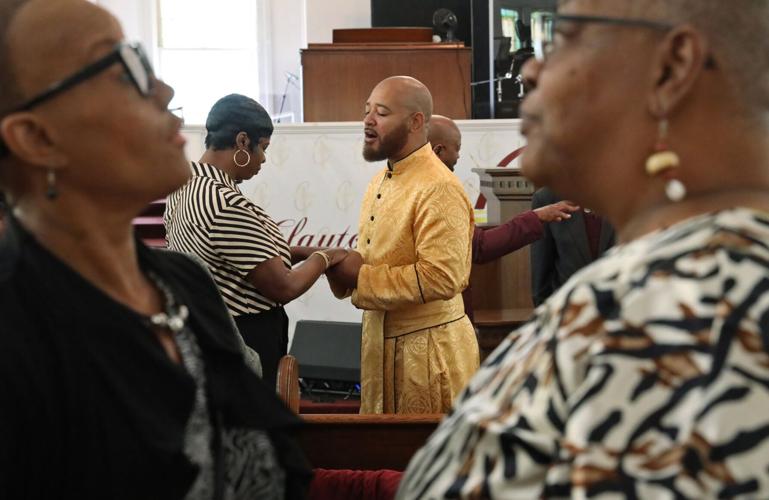
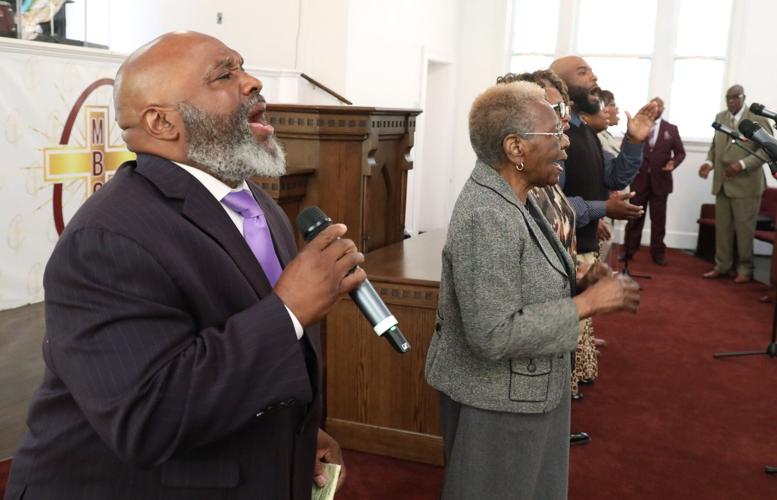
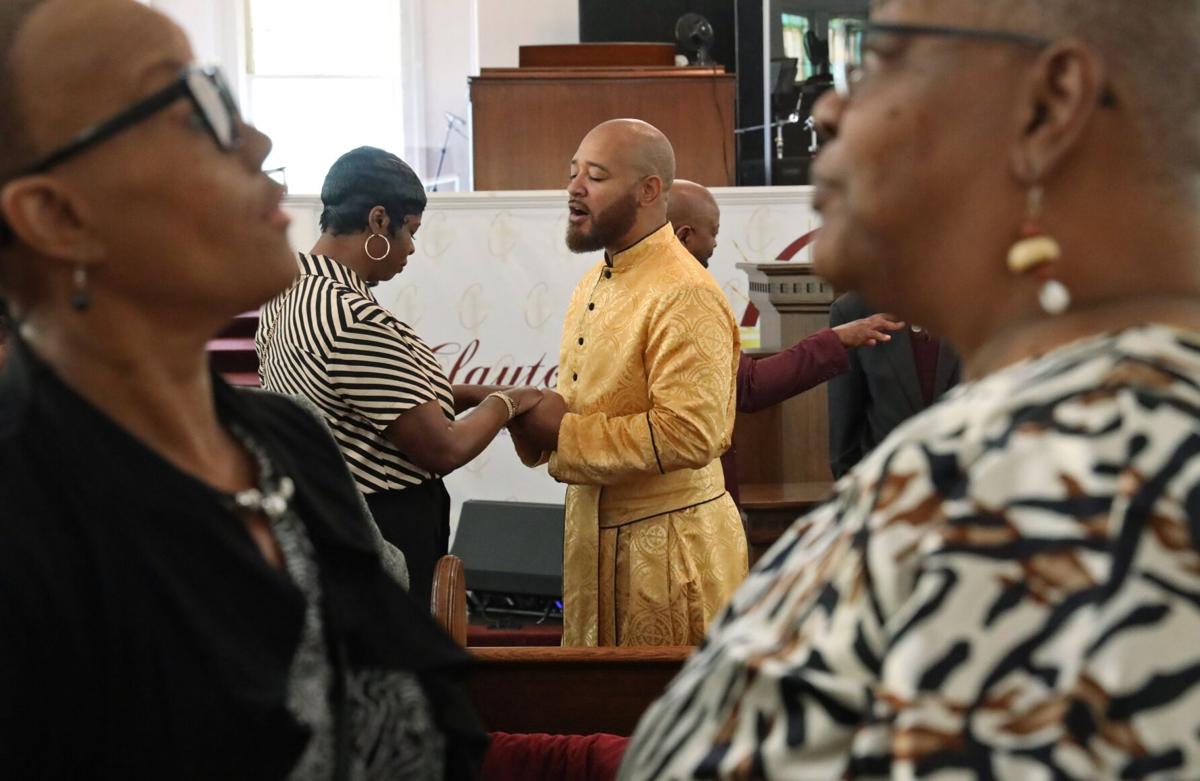
Dr. Cary T. Ball Sr., left, leads the church in singing one of the songs on Sunday, April 26, 2026 at the Clayton Missionary Baptist Church in 最新杏吧原创.
Past and present
Accounts from the early 20th century characterize Rhodes, newly arrived from Mississippi, as committed, charismatic and energetic. Decades later, Tate鈥檚 parishioners describe him in similar terms.
鈥淚 really like Reverend Tate's preaching style,鈥� Palmer, the new parishioner, said. 鈥淏ut also his love that he shows toward each member.鈥�
Tate preaches with vigor and eloquence, sometimes wearing a T-shirt emblazoned with the church logo and other times clad in a three-piece suit. On a Sunday in late March, he embraced church members who shared emotional testimony and later sat in the front pew to encourage three junior pastors whom he鈥檇 assigned to deliver short sermons that day.
Since 2020, he said, church attendance has grown by at least 40 people to 150 total.
鈥淚 do appreciate the growth numerically,鈥� he said, 鈥淏ut my main focus is I see our people鈥檚 spiritual growth through the roof.鈥�

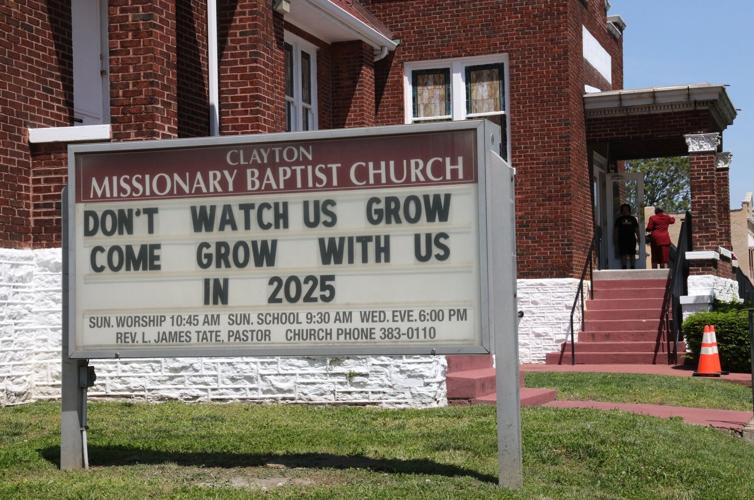
The sign in the front yard on Sunday, April 26, 2026 at the Clayton Missionary Baptist Church in 最新杏吧原创.
The church is now on the cusp of another change. Later this year, it will move to a location on Clara Avenue.
With or without a form of reparations from the City of Clayton, Tate said, the church will live on 鈥� just as it has since its founding in 1893.
Carmen Hill is excited about the new facility on Clara.
鈥淚t's a little bigger than what we have,鈥� she said. 鈥淚t's all on one level, and that's what's really exciting because our congregation is getting older.鈥�
For more information about the River City Journalism Fund, which seeks to support journalism in 最新杏吧原创, go to . Holly Edgell is a local journalist who works as managing editor of .